
At PayG.in (PayG), we facilitate a transparent and efficient merchant onboarding process to expedite payment acceptance and consequent revenue generation for businesses. As a merchant, you can expect continued support and guidance from our sales and account management teams when establishing a relationship and throughout the payment lifecycle thereafter.
PayG is a Payment Aggregator (PA) and adheres to the Know Your Customer (KYC) Direction, 2016 Guidelines. You can thus trust that all your payment transactions with us will be secure and safeguarded against several risks such as fraud, money laundering, terrorism financing, etc.
Through PayG’s fast and frictionless signup process, merchants can start accepting payments with ease; however, they need to ensure that their basic details and requirements are available and updated.
The following are the requirements that need to be adhered to by the merchants for availing PayG's payment gateway services.
Your Onboarding journey begins when you express an interest in PayG solutions and services and continues beyond account activation for tracking periodic updates and continuous due diligence.
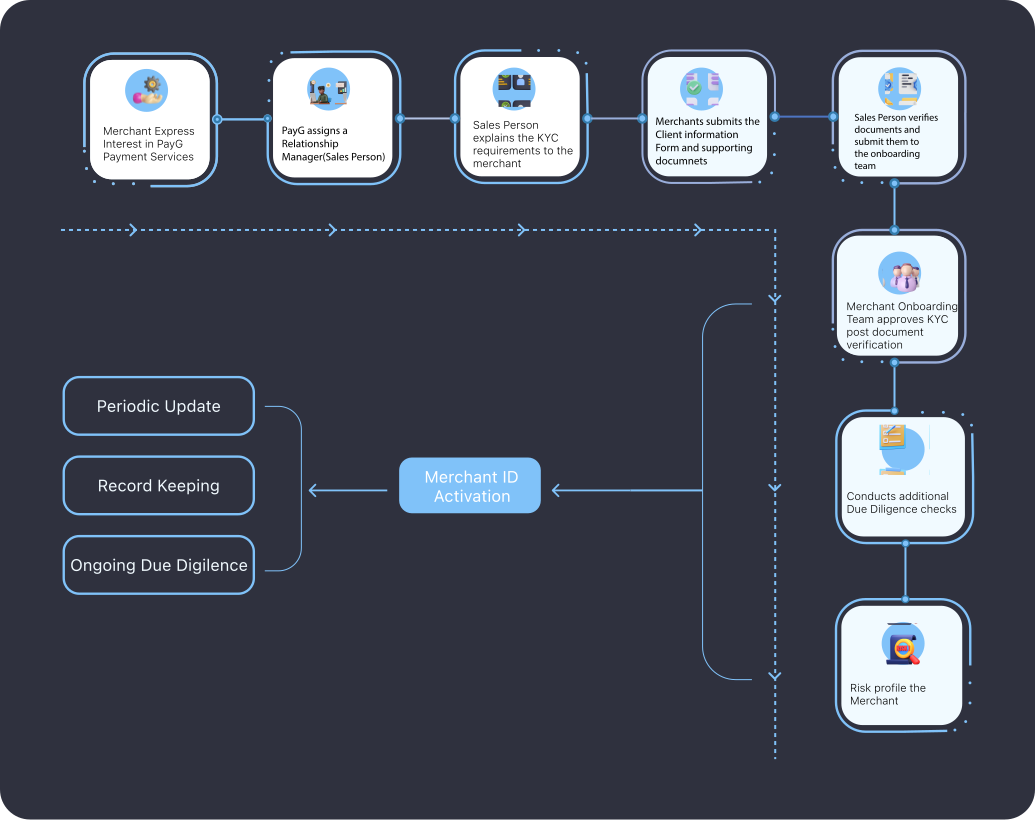
Your Onboarding journey begins when you express an interest in PayG solutions and services and continues beyond account activation for tracking periodic updates and continuous due diligence.
You can express interest in PayG services by:
Our Sales team collates the online forms or emails and forwards them to the Relationship Management team members to initiate the merchant registration process.
Post-registration, you are assigned a Relationship Manager (Sales Person) who will act as a primary Point of Contact (PoC) throughout the onboarding process. The Sales Person will understand the nature of your business and explain the KYC requirements accordingly.
You can submit a duly signed Merchant Application Form (MAF) and other supporting documents to the Sales Person. The Sales Person will perform an initial check of these documents with the originals and submit them to the PayG Merchant Onboarding Team for further verification.
PayG's KYC (Merchant Onboarding) policy aims to establish the merchant's identity, address and existence by verifying documents. The documents that need to be submitted depend on the constitution type of the merchant.
KYC Documentation List - Onboarding
In addition, PayG also needs to identify and know the particulars of the Beneficial Owners of the entity. Beneficial Owner is (are) the natural person(s) who has/have a controlling ownership interest in the entity — Refer clauses 3(a) iv and 34 of RBI Master Direction.
You must submit the KYC documents of the Authorized Signatory and Beneficial Owners. Refer KYC Documentation List – Onboarding (Link will change) to know the document list related to your business.
During acceptance, a PayG employee marks documents received as ‘Original seen and Verified’ by a PayG employee during acceptance.
You can begin your payment journey with PayG once the following verifications are completed:
A Merchant ID (MID) will be issued to you after the completion of the KYC process. Your submitted documents and other information will be retained during the course of the business relationship and at the end of the business relationship as per the RBI guidelines.
You can help us expedite the KYC verification process by providing your Centralised Know Your Customer (CKYC) identifier. In addition, we also need your explicit consent to retrieve your documents from the CKYC portal.
If you have provided these details, we will not require you to submit these documents unless:
We perform regular checks with regulatory databases and risk categorization of our Authorized Signatory and Beneficial Owners. We also undertake Re-KYC for existing merchants on a periodic basis and the periodicity depends on the Merchant's Risk category. We also conduct regular monitoring of transactions to ensure compliance with the PMLA Act and the Rules.
These background activities are conducted on a periodic basis while you continue to use our payment products and services to accelerate your digital business and revenue growth.
As per the set standards, the following details must be available on the merchants’ website/mobile app/electronic invoice raised to collect payments from the customers.
At the initial stage itself, the Merchant is informed by our team of the list of businesses for which payment processing services will not be offered by PayG. He must check whether his business falls under the prohibited list or not, and proceed accordingly. Click here to view detailed information on the prohibited businesses.
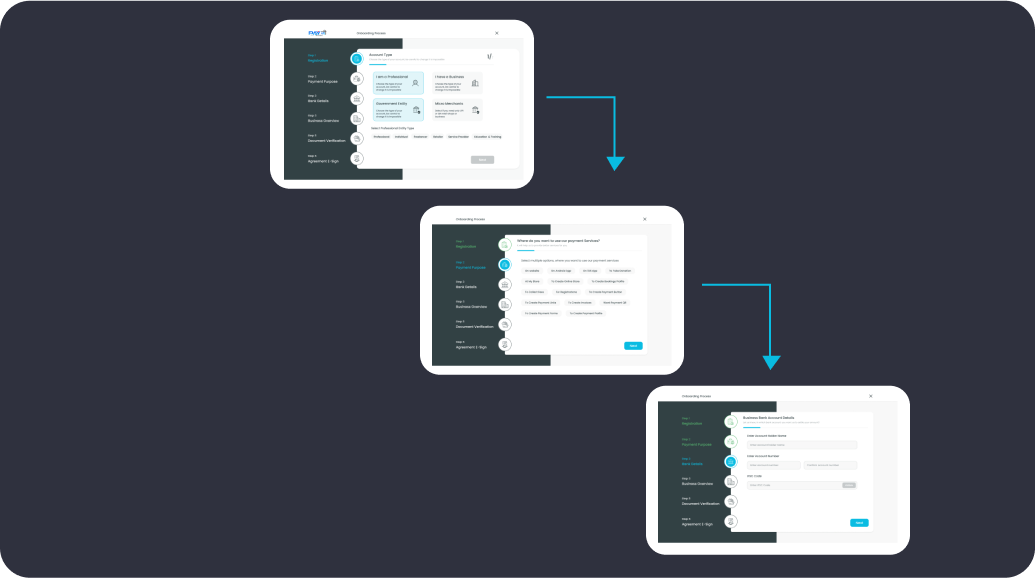
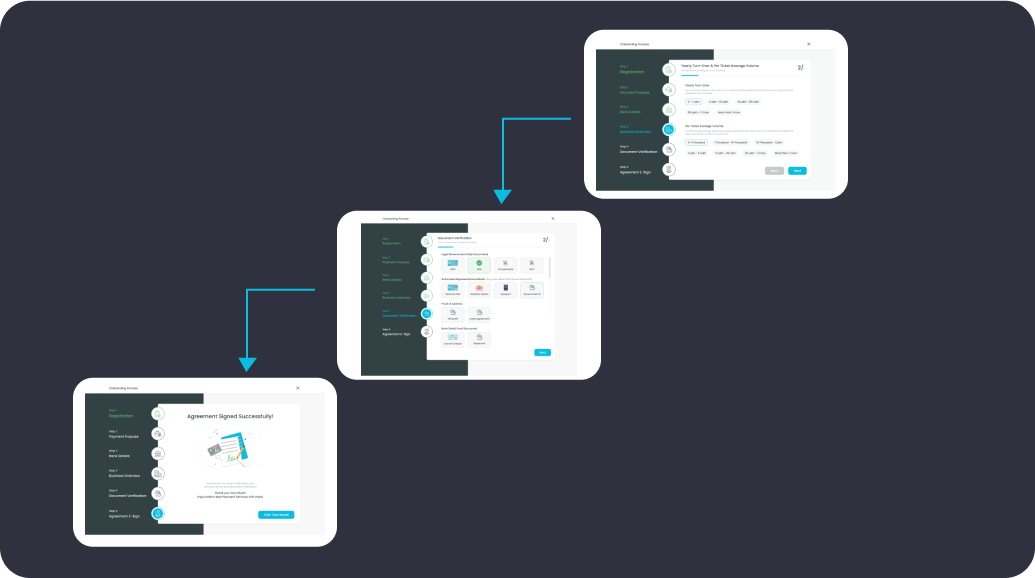
Once the merchants have provided their business, contact & bank details through the online signup process, they need to upload their KYC documents to complete their registration.
This section lists the KYC Documents that merchants need to submit for verification during the merchant on-boarding process.
This section provides the list of KYC documents required for Individual, Beneficial Owner (BO), Authorized Signatory (AS) or Power of Attorney (PoA) holder (related to a Legal Entity) and Sole Proprietor. Certified copies of each of the following documents are required:
OVD includes the following documents:
Where the referred person submits their proof of possession of Aadhaar number as an OVD, they may submit it in such form as issued by the Unique Identification Authority of India.
In case of Non-Resident Indians (NRIs) and Persons of Indian Origin (PIOs) — PayG shall seek to obtain the original certified copy of the above-mentioned documents as defined in the Foreign Exchange Management (Deposit) Regulations, 2016 {FEMA 5(R)}, alternatively, certified by approved authorities/officials in the Directions.
In case the OVD presented by a foreign national does not contain the details of address, PayG shall accept the documents issued by the Government departments of foreign jurisdictions and letter issued by the Foreign Embassy or Mission in India as Proof of Address.
Document requirements vary by business constitution. Expand your company type below to see the exact document checklist.
Section 2(62) of the Companies Act defines a one-person company as a company that has only one person as its member. It's constituted by a single member or “natural entity”, who will be the only associate and director of the individual enterprise. By no means can a third party manage an individual company.
If you have an Individual company then certified copies of each of the following documents are required:
An individual business, also known as a sole proprietorship, is a business structure owned and operated by a single person who assumes complete responsibility for its management, operations, profits, losses, and liabilities. It is commonly chosen by individuals starting small-scale enterprises, freelancers, and independent consultants for its simplicity and minimal regulatory requirements.
If you have a Proprietorship company then certified copies of each of the following documents thereof shall be obtained:
A partnership firm in India is a legal business entity formed by two or more individuals who enter into a partnership agreement to carry on a business together, governed by the Indian Partnership Act, 1932. It offers shared ownership and management while allowing partners to share profits and liabilities.
If you have a Partnership company then certified copies of each of the following documents are required:
An LLP (Limited Liability Partnership) is a partnership in which the partners have limited liability, governed by the Limited Liability Partnership Act, 2008. It offers the advantage of limited liability protection while retaining the flexibility of a partnership structure, and is commonly chosen by professionals and small-to-medium businesses.
If you have an LLP company then certified copies of each of the following documents thereof shall be obtained:
HUF (Hindu Undivided Family) is a legal and tax entity comprising members of a Hindu family, governed by the Hindu Succession Act, 1956 and the Income Tax Act, 1961. It represents a joint family business structure where members pool assets and collectively manage family affairs, commonly used to preserve family wealth and manage ancestral properties.
If you have an HUF company then certified copies of each of the following documents thereof shall be obtained:
A private limited company is a legal entity formed by a group of individuals with a minimum of two and a maximum of 200 members. It has a separate legal identity from its owners, and shareholder liability is limited to their shareholdings. It is preferred by startups and SMEs for its flexibility, credibility, and ease of raising funds.
If you have a Private Ltd. company then certified copies of each of the following documents are required:
A public limited company is a business entity owned by shareholders that offers its shares to the general public. It is registered under the Companies Act, 2013, and has certain features and requirements that differentiate it from other types of companies.
If you have a Public Ltd. company then certified copies of each of the following documents thereof shall be obtained:
A trust company in India acts as a trustee for trusts established under Indian law, managing and safeguarding trust assets in accordance with the trust deed and applicable laws. Trust companies are commonly used for estate planning, asset protection, charitable activities, and managing family wealth.
If you have a Trust company then certified copies of each of the following documents are required:
An NGO, or Non-Governmental Organization, is a legally registered entity formed by individuals or groups with a common purpose to address social, developmental, or humanitarian concerns, complementing government efforts and contributing to social development.
If you have an NGO company then certified copies of each of the following documents are required:
A society company in India, also known as a registered society or nonprofit society, is a legally recognized organization formed by a group of individuals who share a common goal or interest, registered under the Societies Registration Act, 1860, for the promotion of literature, science, art, education, charity, religion, or other socially beneficial objectives.
If you have a Society company then certified copies of each of the following documents thereof shall be obtained:
At the initial stage itself, the Merchant is informed by our team of the list of businesses for which payment processing services will not be offered by PayG. Merchants must check whether their business falls under the prohibited list below before proceeding.
Adult goods and services which include pornography and other sexually suggestive materials (including literature, imagery and other media); escort or prostitution services and massage parlors; payment of potentially sexual related services.
Copyright unlocking devices (mod chips or similar); copyrighted media (unauthorized books, music, movies); copyrighted software (unauthorized software, video games, OEM or bundled software).
Government IDs or documents which include fake IDs, passports, diplomas, and noble titles.
Illegal drugs and drug paraphernalia; unlawful sale of prescription drugs; drug test circumvention aids; online pharmacies selling drugs requiring a prescription.
Counterfeit and unauthorized goods, including replicas of designer goods, fake autographs and counterfeit stamps.
Gaming/gambling including lottery tickets, sports bets, online gambling memberships, casino gaming chips, off-track betting and wagers at race tracks.
Weapons including firearms, ammunition, knives, brass knuckles, gun parts and other armaments.
Cigarettes, cigars, chewing tobacco and related products; unlawful online sale of tobacco to under-age consumers or without proper tax certification.
Endangered species (plants, animals or organisms in danger of extinction); live animals or hides/skins/teeth/nails/parts of animals.
Wholesale currency including discounted currencies or currency exchanges; merchants dealing in cryptocurrencies.
Body parts including organs or other body parts.
Securities including online trading of stocks and bonds, etc.
Cable descramblers and black boxes; pyrotechnic devices and hazardous materials (fireworks, toxic/flammable/radioactive substances); traffic devices (radar detectors/jammers, license plate covers, signal changers).
Goods that promote intolerance or hatred, defame or slander based on race, ethnicity, religion, sex or other factors, encourage violent acts, or relate to crime scenes/items associated with criminals.
Alcohol or alcoholic beverages such as beer, liquor, wine, or champagne.
Pornographic materials involving minors.
Materials including manuals, how-to guides, information, or equipment enabling illegal access to software, servers, websites, or other protected property.
Materials, products, or information promoting illegal goods or enabling illegal acts.
Unsubstantiated cures, remedies or other items marketed as quick health fixes.
Sellers of marijuana used for medicinal purposes.
Air bags, batteries containing mercury, Freon or similar refrigerants, chemical/industrial solvents, government uniforms, car titles, license plates, police badges, lock-picking devices, pesticides, postage meters, recalled items, slot machines, surveillance equipment and other government-regulated goods.
MLM systems requiring participants to pay for recruitment rights, buy fixed inventory to advance, be sold unreasonable quantities (inventory loading), or that restrict reasonable returns.
Work-from-home/earn-online schemes.
Merchandise fulfilled via drop-shipping arrangements.
Ability for card members to purchase foreign exchange currency.
Transacting cheques for cash using a card as a check-guarantee instrument.
Payments to other debt-related real estate products.
Collection agencies, factoring companies, liquidators, bailiffs, credit restoration services, and bankruptcy lawyers.
Unsolicited vendors with immediate payment expected.
Investments made on futures maturity of goods/services intended for return on investment (e.g. stock market, wine futures, horse breeding, timber investment).
Payments to other debt-related real estate products.
Payments to other debt-related real estate products.
Donations to political parties.
Wireless, cable, satellite, wireline, ISP, calling cards, long-distance phone/card readers, airplane telephones, and cellular products/services.
Electronic point-of-sale terminals.
Merchants without a tax exemption or local council registration number.
Road tolls, car parking lots and garages, petrol pumps, cinema kiosks, and railway self-service ticketing.
Any form of auctioning carried out on the Internet (excluding North America region).
Merchants (including e-tickets redeemable in person) and Internet electronic services.
Related establishments such as night club hostesses, night club lounges, discos, or gentlemen's clubs.
All premium-rate (e.g. 1-900) telephone lines.
Selling part ownership of a property for use as a holiday home for a fixed annual period.
Diagnostic, troubleshooting, maintenance and repair services for computers or similar devices.
A party acquired to access a franchiser's proprietary knowledge, processes, and trademarks to sell products or services under the business's name.
Which is not in compliance with all applicable laws and regulations, whether federal, state, local or international, including the laws of India.
Merchants found availing PayG's services for any of the above business types without PayG's written approval will be subject to appropriate proceedings and immediate termination of services.
PayG reserves all rights to approve or disapprove any merchant at its sole discretion.